You can fly with medication in your carry-on or checked bag. TSA allows pills in any amount once screened. Liquid medication over 3.4 oz (100 ml) is allowed in reasonable quantities if you declare it at the checkpoint. TSA doesn't require original bottles, but state labeling laws and your destination's import rules still apply.
Key facts
- Pills and other solid medication: no TSA quantity limit, and no need to declare them.
- Liquid medication over 3.4 oz (100 ml): allowed in carry-on in reasonable quantities; tell the officer at the start of screening.
- Unused syringes are allowed when you also carry the injectable medication.
- Japan: more than one month's supply of prescription medicine needs an import certificate before you travel.
- Singapore: up to 3 months' supply; medicines with controlled substances need prior HSA approval.
Can you bring pills on a plane?
Yes. Pills, capsules and other solid medication are allowed in carry-on and checked bags with no TSA quantity limit. They still go through screening, but you don't need to declare them. This applies to prescription and over-the-counter pills alike.
You can ask for a visual inspection instead of the X-ray. Ask before your medication goes into the X-ray tunnel.
Do pills have to be in prescription bottles?
Not for TSA. A daily pill organizer is fine at the checkpoint. But many states have their own labeling laws for prescription drugs, and TSA expects you to follow them. A photo of the pharmacy label or a printout from your pharmacy is an easy backup.
Abroad, original pharmacy-labeled packaging matters much more. Canada recommends it, and New Zealand and Singapore expect it, as covered below.
Can I bring liquid medication over 3.4 oz?
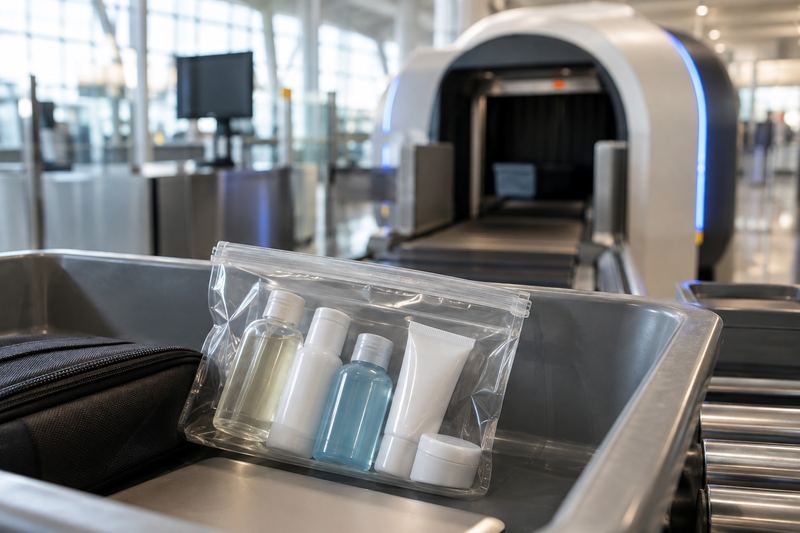
Yes. TSA treats medically necessary liquids, gels and aerosols as exempt from the 3-1-1 rule, in reasonable quantities for your trip. They don't need to fit in your quart-size bag. Tell the officer at the start of screening and take them out of your bag. Expect extra checks, which can include opening the container. Our TSA liquids rule guide covers the standard limits.
Ice packs, freezer packs and gel packs used to keep medication cool are allowed, even if they're partly melted.
One limit applies in both bags: the FAA caps aerosol and flammable medicinal and toiletry items at 18 oz (500 ml) per container and 70 oz (2 L) in total per person. For full details see prescription medication.
Should medication go in my carry-on or checked bag?
Both are allowed, but TSA recommends your carry-on. A checked bag can be lost or delayed, and you can't reach it during the flight. Keep anything you might need quickly, such as a rescue inhaler or an EpiPen, on your person.
Flying with insulin, syringes, inhalers and EpiPens
| Item | Carry-on | What to do at screening |
|---|---|---|
| Insulin and pens | Yes, over 3.4 oz allowed | Declare it and put insulin in a separate bin for X-ray. |
| Syringes | Yes | Unused syringes must be with injectable medication. Used ones go in a sharps container. |
| Insulin pumps and CGMs | Yes | No need to remove them. Tell the officer where they are. Pumps and supplies must be with clearly identified insulin. |
| Inhalers | Yes, outside the liquids bag | Declare them. Labeling is recommended, not required. |
| EpiPens and auto-injectors | Yes, outside the liquids bag | Declare them at the start of screening. |
If you wear a pump or CGM, standard lanes usually involve a self pat-down and hand swab. In PreCheck that happens only if it alarms. Nebulizers can stay in their case for X-ray, and nebulizer liquids are exempt from the 3-1-1 rule in reasonable amounts.
Can I bring a CPAP machine on the plane?
Yes. TSA allows CPAP, BiPAP and APAP machines. In standard lanes you may need to take it out of your bag for X-ray, though it can stay in its case. US airlines can't count an assistive device like a CPAP toward your carry-on limit under DOT rules. Keep a battery-powered unit and any spare lithium batteries in the cabin; spare lithium batteries are banned from checked bags. If you plan to use it in flight, ask your airline in advance. See CPAP machines.
Flying with medication internationally
Two sets of rules apply: airport security on the way out, and the import rules of the country you're entering. Import rules are often stricter, especially for controlled drugs, so check them before you book. As of October 2026:
| Destination | Security (liquids) | Bringing medicine in |
|---|---|---|
| Japan | Liquid medicine over 100 ml on international flights: show a prescription copy, pharmacy bag or doctor's certificate | Up to one month's supply of prescription medicine without paperwork. More needs an import certificate (Yunyu Kakunin-sho) before travel. Narcotics and specially controlled drugs are not covered by this allowance. |
| Singapore | Liquid medicine over 100 ml needs a genuine doctor's letter | Up to 3 months' supply. Controlled substances need HSA approval; apply at least 2 weeks before arrival. Keep pharmacy-labeled packaging and a prescription copy. |
| United Kingdom | Essential medicines over 100 ml allowed, up to 2 litres; liquids over 100 ml need proof of prescription | Medicines containing controlled drugs have separate rules on gov.uk. |
| European Union | Essential medicines over 100 ml allowed for the trip; you may be asked to prove they're genuine | Check the rules of the country you're visiting. |
| Canada | Liquid medicines may exceed 100 ml and stay out of the 1-litre bag; show all medication to the officer | Canada restricts the quantities and types of health products travelers bring in. See Health Canada's GUI-0116 guidance or ask CBSA. |
| New Zealand | Prescribed medicine may exceed liquid limits if the prescription is in your name, in original packaging, and covers your travel time | Check New Zealand's import rules before you travel. |
| Australia | Medicines exempt from liquid and powder limits; carry evidence such as a doctor's letter | Check the TGA's rules before you travel. |
A medicine sold over the counter at home may need a prescription where you're going. Canada's border agency, for example, warns about this. Japan's allowances also exclude certain drugs entirely, so check before you pack anything controlled.
A simple packing checklist
- Keep all medication in your carry-on, with liquids where you can take them out quickly.
- For international trips, use original pharmacy-labeled packaging.
- Bring a copy of each prescription, or a doctor's letter that lists your medicines, in your name.
- Make sure the amount you carry is within your destination's limit.
- Check your destination's import rules for each medicine, especially anything that may be a controlled drug there.
- Keep cooling packs with temperature-sensitive medication.
- Need help at the checkpoint? TSA Cares (855-787-2227) can arrange assistance if you call 72 hours before your flight.
Questions about timing doses across time zones or how much to bring are for your doctor or pharmacist. This guide covers carry rules only.
Questions people ask
Do I need to tell TSA about my medication?
Only liquid, gel or aerosol medication needs to be declared. Pills and other solids are screened without being declared. The officer has the final say on any item.
Can I put my pills in a pill organizer when flying?
Yes, TSA allows it. Your state's prescription labeling laws still apply, and for international trips original packaging is safer.
Can I bring vitamins on a plane?
Yes. Vitamin pills and supplements are allowed in carry-on and checked bags. Liquid vitamins are limited to 3.4 oz (100 ml) per container in carry-on. See vitamins.
How much medication can I take to Japan?
Up to one month's supply of prescription medicine for personal use without paperwork. For more, you need an import certificate before you travel, and some controlled drugs are not allowed under this allowance.
Do I need a doctor's letter to fly with medication?
TSA doesn't require one. The UK requires proof for liquid medicines over 100 ml, Singapore requires a doctor's letter for them, and a letter or prescription copy helps at most borders.
Sources
- TSA: Can you pack your meds in a pill case? And more questions answered
- TSA: Medications (liquid)
- TSA: What can I bring? Medical
- TSA: Insulin
- TSA Cares: Disabilities and medical conditions
- TSA: Nebulizers, CPAPs, BiPAPs and APAPs
- FAA PackSafe: Medicinal and toiletry articles
- eCFR: 14 CFR 382.121, assistive devices in the cabin
- MHLW (Japan): Q&A on bringing medicines into Japan
- MLIT (Japan): Restrictions on liquids in the cabin on international flights
- Health Sciences Authority (Singapore): Travelling with medications to Singapore
- Changi Airport: Security and baggage restrictions
- GOV.UK: Hand luggage restrictions, medicines and medical equipment
- European Commission: Information for air travellers
- CATSA: Medication and medical items
- CBSA: Declare to the CBSA
- Aviation Security Service (NZ): Powders, liquids, aerosols and gels
- Melbourne Airport: Powder restrictions