Yes, you can bring a power bank on a plane, but only in your carry-on, never in checked luggage. Power banks up to 100 Wh need no approval, 101–160 Wh need airline approval (two at most), and anything over 160 Wh is banned. Most international flights now also cap you at two and forbid recharging them on board.
Key facts
- Carry-on only: power banks count as spare lithium batteries and are banned from checked bags, including gate-checked bags.
- Up to 100 Wh: no approval. 101–160 Wh: airline approval, maximum two. Over 160 Wh: forbidden.
- Since 27 March 2026, the ICAO rule for international flights allows at most two power banks per passenger and bans recharging them on board.
- A 20,000 mAh power bank at 3.7 V is 74 Wh, well under the 100 Wh limit.
- Many airlines also ban or restrict using a power bank during the flight and keep them out of overhead bins.
What size power bank can I bring on a plane?
Airlines and regulators measure power banks in watt-hours (Wh), not mAh. Under FAA rules, which the UK and ICAO mirror, the limits for each power bank are:
- 100 Wh or less: allowed in your carry-on with no approval. This covers almost every phone and tablet power bank.
- 101–160 Wh: allowed only with your airline's approval, and no more than two per person. Several airlines, including Southwest, American and Delta, accept only power banks of 100 Wh or less, so ask before you fly. Our guide to getting a large power bank approved covers the process.
- Over 160 Wh: forbidden on passenger aircraft.
Most labels show mAh. At the usual 3.7 V cell voltage, a 20,000 mAh power bank is 74 Wh, a 27,000 mAh one is 99.9 Wh (just under the limit), and a 30,000 mAh one is 111 Wh, which needs approval. If your label doesn't print Wh, use the mAh to Wh converter or read our explainer on what a watt-hour is.
Larger power banks may get harder to fly with. IATA has told airlines that its dangerous goods regulations taking effect on 1 January 2027 won't keep the option of approving 101–160 Wh power banks, so expect more international airlines to refuse them from next year.
Why can't power banks go in checked luggage?
A lithium battery that overheats can catch fire, and a fire in the cabin can be spotted and handled by the crew. A fire inside a suitcase in the hold can't. That's why the FAA requires power banks and other spare lithium batteries to travel with you.
The same logic now applies inside the cabin. In August 2025 the FAA warned airlines (SAFO 25002) that batteries in overhead bins or inside stowed bags are hard to see and reach if they overheat. Many airlines now ask you to keep power banks in the seat pocket, in your personal item under the seat, or on your person.
If the gate agent takes your roller bag to check it at the gate or planeside, take the power bank out first and keep it with you.
How many power banks can I bring?
It depends on where you fly, and on your airline.
- International flights: since 27 March 2026 the ICAO rule allows a maximum of two power banks per passenger. The UK CAA applies the same limit. Japan (from 24 April 2026), Singapore (from 15 April 2026) and Malaysia (from 30 April 2026) have written it into national rules.
- US domestic flights: as of October 2026, the FAA and TSA set no count for power banks of 100 Wh or less, but the FAA says airlines can set stricter limits, and many have. Southwest allows one power bank per customer, and American, Delta and JetBlue allow two.
- Some airlines allow only one: Emirates and Etihad, for example.
Check your airline's rules before you pack a second one. Our airline power bank rules hub has the details by carrier.
Can I use or charge a power bank during the flight?
Recharging the power bank itself from seat power is now banned almost everywhere. The 2026 ICAO rule forbids it, and so do Southwest, American, Delta and JetBlue. Using a power bank to charge your phone is a separate question:
- Many airlines in Asia, Europe and the Middle East ban any use on board.
- Some, including Delta, Qatar Airways and Ryanair, allow you to charge devices from it outside taxi, take-off and landing, or only while it stays in view.
- The UK CAA advises passengers not to use power banks to charge other devices on board.
| Using it on board | Size limit | ||
|---|---|---|---|
| Air France | Banned | 2 | 100 Wh160 Wh with approval |
| AirAsia | Banned | 2 | Not statedNot stated |
| All Nippon Airways (ANA) | Banned | 2 | 100 Wh160 Wh with approval |
| American Airlines | With conditions | 2 | 100 WhNot allowed |
| British Airways | Allowed | 2 | 100 WhNot allowed |
| Cathay Pacific | Banned | 2 | Not statedNot stated |
| Delta Air Lines | With conditions | 2 | 100 WhNot allowed |
| EVA Air | Banned | 2 | 100 Wh160 Wh with approval |
| Emirates | Banned | 1 | 100 WhNot allowed |
| Etihad Airways | Banned | 1 | 100 WhNot allowed |
| Japan Airlines | Banned | 2 | 100 Wh160 Wh with approval |
| JetBlue | Banned | 2 | 100 WhNot stated |
| Lufthansa (Lufthansa Group) | Banned | 2 | 100 Wh160 Wh with approval |
| Qantas | Banned | 2 | 100 Wh160 Wh with approval |
| Qatar Airways | With conditions | 2 | 100 WhNot allowed |
| Ryanair | With conditions | 2 | 100 WhNot allowed |
| Singapore Airlines | Banned | 2 | 100 Wh160 Wh with approval |
| Southwest Airlines | With conditions | 1 | 100 WhNot allowed |
| Thai Airways | Banned | 2 | 100 WhNot allowed |
| Turkish Airlines | Banned | 2 | 100 WhNot allowed |
| Virgin Australia | Banned | 2 | 100 Wh160 Wh with approval |
Where use is allowed, keep the power bank and the device you're charging in sight, not tucked inside a bag. Tell a flight attendant immediately if either gets hot, swells, smokes or smells odd.
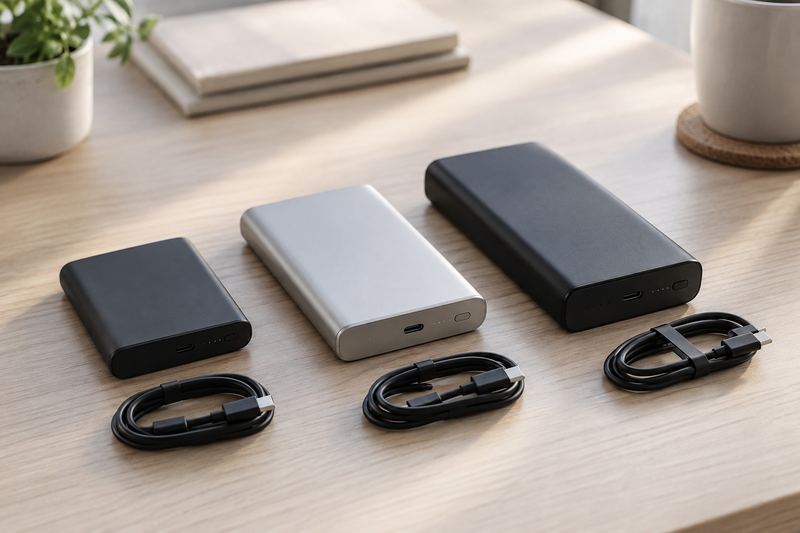
Common power bank sizes: are they allowed?
Here is how popular capacities convert at 3.7 V, with the carry-on verdict for each. Treat it as a guide: if your power bank's label states a Wh figure, that figure is the one that counts.
| Capacity | At 3.6 V | At 3.7 V | At 3.85 V | Verdict at 3.7 V |
|---|---|---|---|---|
| 5,000 mAh | 18 Wh | 18.5 Wh | 19.2 Wh | Carry-on, no approval |
| 10,000 mAh | 36 Wh | 37 Wh | 38.5 Wh | Carry-on, no approval |
| 15,000 mAh | 54 Wh | 55.5 Wh | 57.8 Wh | Carry-on, no approval |
| 20,000 mAh | 72 Wh | 74 Wh | 77 Wh | Carry-on, no approval |
| 25,000 mAh | 90 Wh | 92.5 Wh | 96.2 Wh | Carry-on, no approval |
| 26,800 mAh | 96.5 Wh | 99.2 Wh | 103.2 Wh | Carry-on, no approval |
| 27,000 mAh | 97.2 Wh | 99.9 Wh | 104 Wh | Carry-on, no approval |
| 30,000 mAh | 108 Wh | 111 Wh | 115.5 Wh | Needs airline approval |
| 40,000 mAh | 144 Wh | 148 Wh | 154 Wh | Needs airline approval |
| 50,000 mAh | 180 Wh | 185 Wh | 192.5 Wh | Not allowed |
The sizes people most often ask about are the 20,000 mAh power bank (74 Wh, fine) and the 27,000 mAh power bank (99.9 Wh, just under the limit at 3.7 V). For the exact verdict on yours, try the power bank checker.
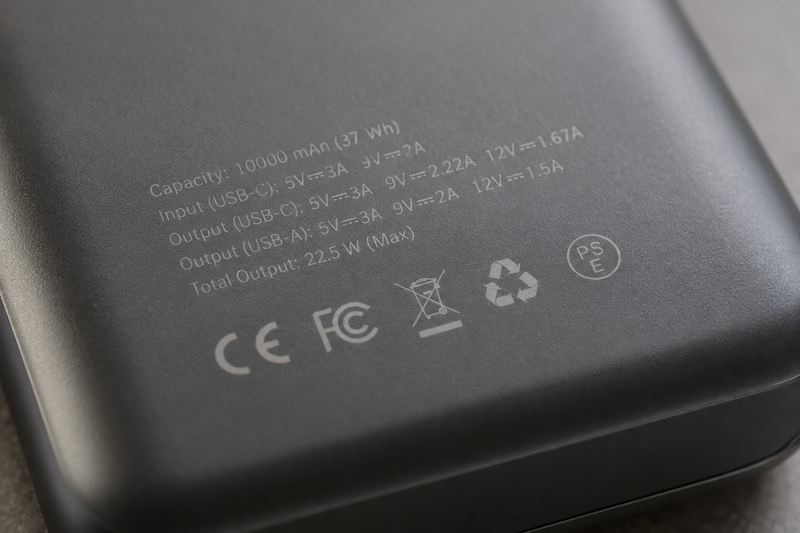
How do I read the label on my power bank?
Look on the back or edge of the case for the specification block. The figures that matter:
- Wh (watt-hours): the number airlines use. If it's printed, you're done: 100 Wh or less is fine without approval.
- mAh and V: the cell capacity and cell voltage, often written as "20000mAh 3.7V". Multiply them and divide by 1,000 to get Wh.
- Rated capacity: some labels add a second, smaller mAh figure measured at the 5 V USB output. Don't use that one with 5 V to work out Wh. Use the cell capacity and cell voltage.
- Battery type: almost all power banks are lithium-ion. A lithium-metal power bank would be limited to 2 g of lithium instead.
- Certification marks: the CCC (3C) mark matters on domestic flights in China (see below).
Cells are usually 3.6–3.85 V, so the same mAh can produce slightly different Wh figures. At 3.85 V a 27,000 mAh pack works out to about 104 Wh, which is over the limit, so always go by the printed Wh when there is one.
China's 3C rule for domestic Chinese flights
Since 28 June 2025, the Civil Aviation Administration of China (CAAC) has banned power banks on domestic flights within mainland China if they:
- have no China Compulsory Certification (3C or CCC) mark,
- have a 3C mark that can't be read clearly, or
- belong to a model or batch that has been recalled.
CAAC also requires the Wh rating to be clearly legible. The usual limits still apply: up to 100 Wh in carry-on, 101–160 Wh with airline approval (two maximum), nothing over 160 Wh, and never in checked baggage. A power bank bought outside China may have no 3C mark at all. If you have a domestic leg inside China, expect it to be refused at screening.
What happens at security if the label is missing or worn off?
Neither the FAA nor TSA publishes a specific rule for unmarked power banks. But the limits are set in Wh, and without a readable rating nobody can confirm yours is under 100 Wh. The TSA officer has the final say at US checkpoints, and an officer or the airline can refuse a power bank whose capacity can't be checked. Several airlines go further. Emirates and British Airways require the capacity rating to be visible, Etihad requires a clearly marked rating, and in China the Wh rating must be legible.
If a label is scuffed, faded or covered by a sticker or case, replace the power bank before your trip. Don't count on talking your way through at the gate.
Packing checklist
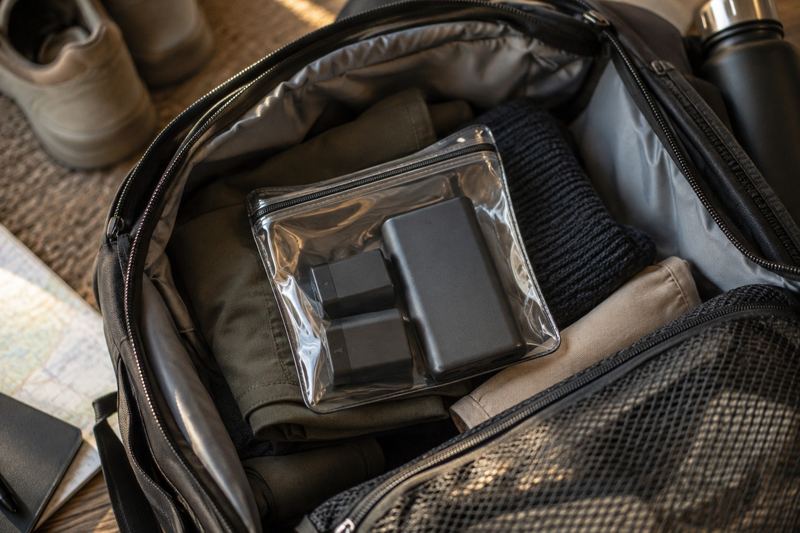
- Put it in your carry-on or personal item, not your checked bag.
- Bring no more than two (one on some airlines), each 100 Wh or less unless you have airline approval.
- Protect the ports and terminals: switch it off, use a pouch, and keep it away from keys and coins.
- Keep it under the seat or in the seat pocket, not in the overhead bin.
- Don't plan to recharge it on board.
- Leave behind any power bank that is swollen, damaged or recalled. The FAA bans damaged and recalled batteries.
For other battery types, from camera batteries to AA cells, see our guide to lithium batteries on planes and the power bank item page.
Questions people ask
Is a 20000mAh power bank allowed on a plane?
Yes, in your carry-on. At 3.7 V a 20,000 mAh power bank is 74 Wh, under the 100 Wh limit, so it needs no airline approval.
What is the maximum power bank size I can take on a plane?
100 Wh (about 27,000 mAh at 3.7 V) without approval. Up to 160 Wh is possible only with your airline's approval, and many airlines don't approve power banks over 100 Wh.
Can I put a power bank in checked luggage?
No. Power banks must stay with you in the cabin, including when your carry-on is gate-checked.
Can I charge my phone with a power bank on the plane?
It depends on the airline. Many carriers, including Emirates, Lufthansa, Singapore Airlines and Qantas, ban using power banks on board, while others such as Delta allow it outside taxi, take-off and landing. You cannot recharge the power bank itself on board.
Is a 30000mAh power bank allowed on a plane?
At 3.7 V it is 111 Wh, which is over 100 Wh, so you need airline approval and many airlines won't give it. Check the Wh on the label and your airline's page before flying.
Why is there an airline power bank ban?
Lithium battery fires in the cabin led ICAO and many airlines to tighten the rules in 2025–2026. The changes cap how many you can carry, ban recharging power banks on board and keep them out of overhead bins. Most airlines still let you carry power banks; what they restrict is using them on board.
Sources
- FAA: PackSafe – Lithium batteries
- FAA: Airline passengers and batteries
- FAA: SAFO 25002 – Lithium batteries carried by passengers
- TSA: Power banks
- ICAO: New power bank restrictions will safeguard international aviation
- IATA: Guidance to operators – power banks
- UK CAA: Changes to rules on the carriage of lithium cells/batteries and power banks
- CAAC: Ban on power banks without 3C marks or from recalls on domestic flights
- CAAC: Air travel guidance on power banks
- MLIT (Japan): New rules for handling power banks on aircraft
- CAAM: Safety Directive SD 01/2026
- CAAS: New power bank safety restrictions on flights departing Singapore
- Southwest Airlines: Power banks/portable chargers
- American Airlines: Restricted items
- Delta Air Lines: Battery or fuel-powered items
- JetBlue: Batteries
- Emirates: Changes to safety rules for customer usage of power banks onboard
- Etihad Airways: Prohibited items and dangerous goods
- British Airways: Liquids and restrictions